

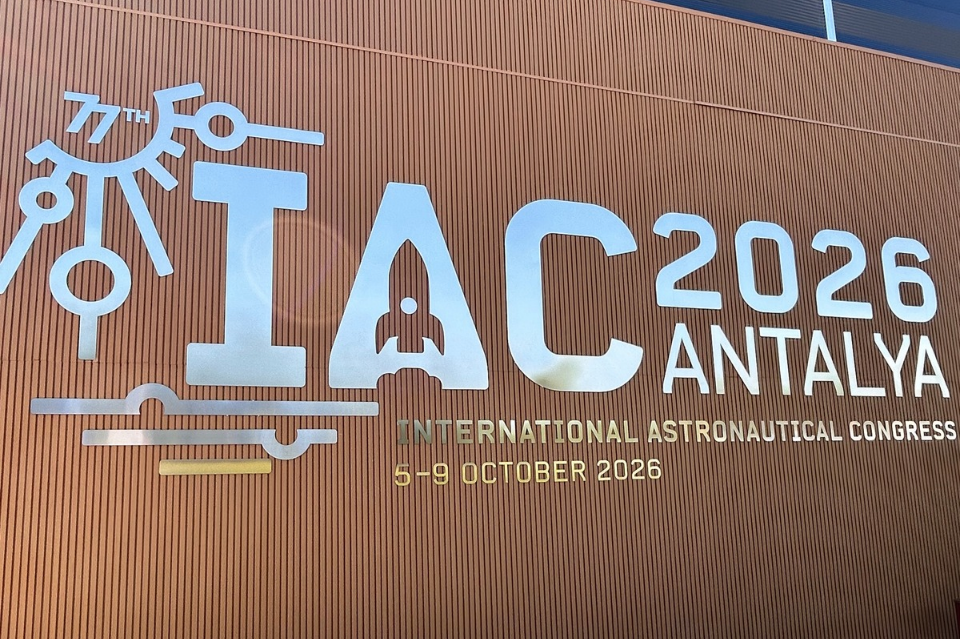
At this year’s International Astronautical Congress, André Ribeiro, Flight Dynamics Engineer, and Marta Guimarães, AI Researcher at Neuraspace, presented two technical papers addressing challenges in space operations.
André’s work focuses on maintaining spacecraft custody during the Launch and Early Operations Phase (LEOP), while Marta’s research compares object type classifications in SATCAT and DISCOS and explores machine learning for object type inference. Below, we highlight the main ideas and findings from both papers.
Paper 1 : DISCOS vs SATCAT: From Catalogue Discrepancies to Object Type AI Inference
Authors: Marta Guimarães, Robert Arthur, Cláudia Soares, Chiara Manfletti
Challenge
SATCAT and DISCOS use different classification schemes for space objects. This can lead to discrepancies, particularly in how unknown and debris-related objects are classified.
Approach
The study harmonises the two classification schemes and compares object type assignments using a consistent snapshot of both catalogues. Discrepant cases are manually labelled using retrospective catalogue updates and auxiliary information, creating a reconciled dataset. This dataset is then used to train a supervised machine learning model to infer object types when catalogue information is missing, ambiguous or conflicting.
Key Findings
- Identification of discrepancies between SATCAT and DISCOS
- Analysis of recurring differences in object classification
- Creation of a manually curated reference dataset
- Development of a supervised machine learning model for object type inference
- Probabilistic object type estimates for cases with incomplete or conflicting information
Practical Impact
The study demonstrates how machine learning can support object type classification when catalogue information is incomplete, delayed, or inconsistent, complementing existing catalogue data with data-driven inference.
Paper 2: Orbital Phase Correction Method to Improve Custody Maintenance in LEOP
Authors: André Ribeiro, Robert Arthur, Chiara Manfletti, Gerarda De Pasquale
Challenge
The Launch and Early Operations Phase (LEOP) is a critical part of any space mission, where it is crucial to maintain spacecraft custody by means of consistent and accurate knowledge of the orbital state. During the initial commissioning days, severe battery budget constraints can result in extremely restricted GNSS datasets. This can introduce a significant operational risk if the predicted states deviate too far from reality.
Approach
The paper proposes a Phase Correction Algorithm that applies discrete time adjustments to the orbit prediction from the separation state vector, reducing the along-track error using highly sparse and short GNSS tracks.
Key Findings
- The algorithm can successfully reduce the along-track drift with as few as 5 GNSS measurements per orbit
- 90.46% success rate for Sat. A and 94.34% for Sat. B
- Lightweight and computationally efficient
Practical Impact
The approach acts as an operational “safety net”, maintaining the spacecraft within the ground station’s beam-width significantly longer than uncorrected propagation, until onboard systems are fully commissioned and continuous data provision begins.
-2.png?height=200&name=LinkedIn_Neura%20(1)-2.png)
-2.png?height=200&name=Newsletter%20(4)-2.png)
-1.jpg?height=200&name=2025_recap%20(1)-1.jpg)